Callum booked his first driving lesson the week after his seventeenth birthday. He had been watching driving videos on YouTube for months. He knew what a clutch was. He had memorised the highway code questions his older brother had tested him on. He was confident.
Forty minutes into that first lesson, he stalled on a residential road in Luton, panicked, forgot to apply the handbrake, and rolled slowly into a parked car. No damage. No injury. But the look on his face said everything — the gap between knowing about driving and actually driving was enormous and had just become very, very real.
That gap is where most beginner drivers live for the first five to ten lessons. And closing it as efficiently as possible — with the right safety habits built in from the very start — is the difference between a learner who passes in 40 hours and one who needs 60.
Here is something most beginner driving guides will not tell you directly: the safety habits you form in your first five lessons will follow you for the rest of your driving life. Not the skills — skills develop gradually. The habits. How you check your mirrors. Whether you genuinely look at junctions or just move your head. How you respond to unexpected hazards. These patterns set early and they set deep.
This guide covers the top safety tips for beginner driving lessons — not the generic advice you will find on every other page, but the specific, practical, experience-based knowledge that genuinely helps beginners build safe driving habits and pass their driving test with confidence.
What Should a Complete Beginner Expect From Their First Driving Lesson?
A good first driving lesson in Luton for a complete beginner covers the basics of vehicle familiarisation, moving off, and stopping — in a low-traffic environment with patient, step-by-step guidance. Expect to feel overwhelmed. That is completely normal and it passes faster than you think.
The first lesson is not about covering ground. It is about first contact — getting familiar with how a car responds to your inputs, understanding the controls, and experiencing the feeling of being responsible for a moving vehicle for the first time. Most beginners find the first lesson simultaneously easier and harder than expected. Easier because the car does not immediately do something terrible. Harder because the mental load of processing everything at once is genuinely exhausting.
What You Will Learn in Your First Lessons
Here is the thing Callum did not realise going into his first lesson: YouTube videos teach you vocabulary, not fluency. You can watch a hundred videos about clutch control and still be surprised by how the car responds the first time you actually try it. That surprise is not failure. It is the beginning of real learning.
What you should expect to cover in lessons one through three as a complete beginner: the cockpit drill and vehicle checks, moving off and stopping in a controlled environment, basic steering and lane positioning, changing gears one through to third in a manual car, and first encounters with very light traffic on quiet residential roads.
What you should not expect: to be on a busy A-road. To be ready for roundabouts. To feel confident. All of that comes later, built on the foundation of these early lessons done well.
Why Safe Driving Habits Built Early Last a Lifetime
Strong habits formed in your first lessons stay with you for life
Beginners who learn proper observation and control from day one develop natural, consistent driving habits that are hard to break later.
Rushing early training leads to weak, hard-to-fix habits
Skipping basics to reach advanced skills faster often creates poor habits that are difficult and costly to correct.
Examiners spot real habits vs. fake routines
DVSA examiners can tell the difference between genuine awareness and mechanical actions, rewarding drivers with real understanding.
Safe driving is the foundation, not an add-on
Building strong habits early makes learning faster, improves consistency, and increases your chances of passing first time.
The Mirror-Signal-Manoeuvre Routine: Why Beginners Get It Wrong and How to Fix It
MSM is the foundation of safe driving and test success
The Mirror–Signal–Manoeuvre routine (MSM) is introduced early but remains one of the most common causes of driving test faults because learners treat it as a sequence, not a habit.
Why beginners struggle with MSM on the driving test
Many learners check mirrors and signal mechanically instead of using MSM to genuinely understand and respond to real road situations.
Mirrors — gather real information before every action
Mirror checks are about awareness. Before turning, changing speed, or switching lanes, you must clearly understand what is behind and beside you through proper observation.
Signal — communicate your intention clearly and at the right time
Signalling is not a routine step but a way to inform other road users of your next move. Correct timing and intention make your signal effective.
Manoeuvre — act only after awareness and communication
A manoeuvre should only happen once you have checked your surroundings and signalled. It includes correct position, speed, and continuous observation.
Practise MSM as a thought process, not a checklist
Ask yourself: do I know what’s around me, have I communicated clearly, and am I in the right position and speed? Turning MSM into a habit ensures safer driving and better test performance.
Speed Awareness for Beginners: The Two Mistakes That Cause Most Early Faults
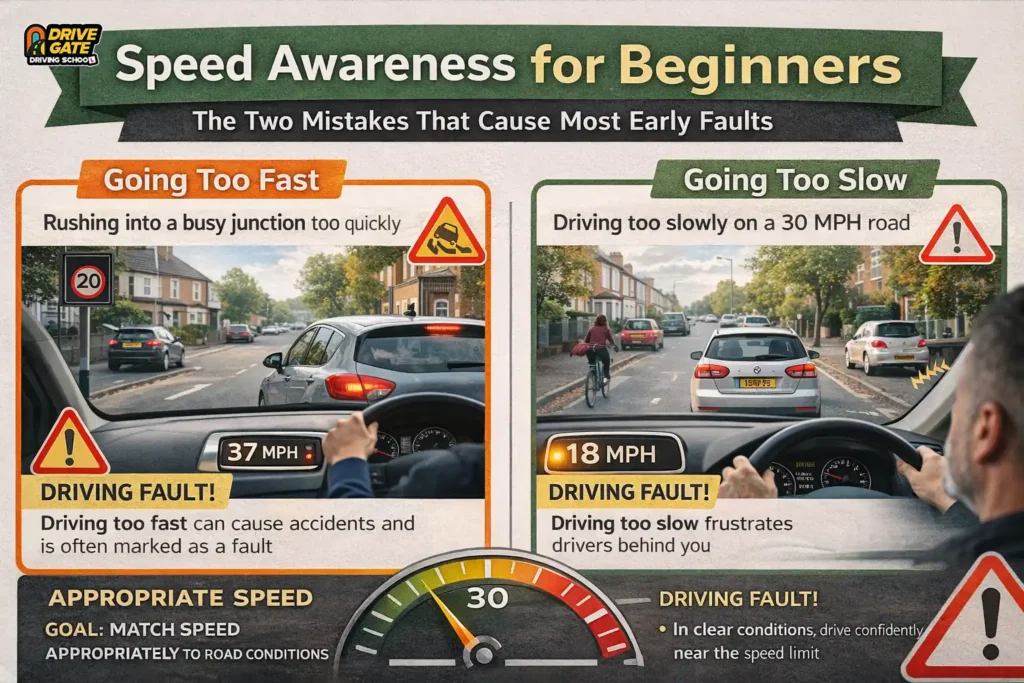
Beginners often make two key mistakes: driving too fast into hazards or too slow in clear conditions. Both can lead to faults in the driving test. The goal is not slow driving, but appropriate speed—adjusting confidently to road conditions, whether on 30mph streets or 40mph A-roads like Dunstable Road or New Bedford Road. This is exactly what you learn through a structured driving lesson process designed to build confidence step by step.
Hazard Perception for Beginners: Seeing What Others Miss

Hazard perception is the ability to spot and respond to developing risks early — a key skill for safe driving and passing your test. It includes both obvious hazards and less visible ones, like a parked van or a child about to enter the road. Beginners improve this by practising commentary driving, which helps turn awareness into habit. Using tools like the DVSA Hazard Perception Practice app and Theory Test Pro also builds the timing and judgement needed for the test.
Clutch Control for Beginners: The Skill That Makes Everything Easier
Clutch control is one of the biggest challenges for beginners learning in a manual car, but once mastered, it makes driving much smoother and more enjoyable.
Understanding the biting point
The biting point is where the engine starts transferring power to the wheels. Controlling this point prevents stalling and helps you move off smoothly.
How to find the biting point
Use your senses — listen for the engine sound dropping and feel the car slightly lift. These signals tell you the clutch is engaging.
Why beginners stall and how to fix it
Stalling usually happens when the clutch is released too quickly. Practising slowly and holding the biting point helps build control and confidence.
Practise to build muscle memory
Repeating clutch control exercises in quiet areas helps develop consistency and makes moving off easier over time.
Stalling in the driving test is not an automatic fail
One stall is usually just a minor fault if handled calmly. Examiners focus more on how you recover than the mistake itself.
Understanding Road Markings and Signs: What Beginners Often Misread
| Road Features | What it Means | Common Beginner Mistake |
|---|---|---|
|
Give Way Line |
Broken White Line-Slow Down and give Priority if needed |
Stopping Unnecessarily |
|
Stop Line |
Solid White Line-Must Stop Completely |
Rolling Through Without Stopping |
|
20mph zone |
Area-wide limit with calming measures |
Not recognising zone entry |
|
20mph Limit sign |
Standard Speed Limit Sign |
Confusing with zone rules |
|
Yellow Box Junction |
Do not enter until the exit is clear(except turning Light) |
Entering When blocked/avoiding unnecessarily |
Many beginners confuse give way and stop lines. A give way line requires you to slow down and assess traffic, while a stop line requires a complete stop regardless of conditions.
A 20mph zone applies to an entire area and often includes traffic calming measures. A 20mph speed limit is a standard sign without additional features.
Yellow box junctions are designed to keep traffic flowing. Enter only when your exit is clear, except when turning right.
What Beginner Drivers Should Know About Driving in Different Conditions

Driving in different conditions is an important part of beginner driving lessons. Rain, bright sun, and cold mornings can all affect visibility and control, so learners must adapt their driving accordingly.
Understanding these situations and following safe driving practices helps build confidence and improves your chances to pass your driving test successfully.
Passing Your Driving Test First Time: What Safety-Focused Beginners Do Differently
The first-time pass rate for the practical driving test nationally sits at approximately 48% as of 2025. That means just over half of all test candidates fail on their first attempt. The candidates who pass are not always the most naturally talented drivers. They are the most consistently safe drivers — and there is a difference.
Here is the pattern among first-time passers that no generic guide captures well enough: they drive for their examiner, not despite them. What I mean is this. Some candidates become so focused on performing for the examiner that their driving becomes unnatural, stilted, and inconsistent. First-time passers drive exactly as they have been trained to drive throughout their lessons — no more theatrical mirror checks, no forced demonstration of safety habits. Just normal, consistent, safe driving that is completely habitual by test day.
This is why the habits formed in beginner driving lessons matter so profoundly. If your observation checks are genuine habits by the time you reach test standard, you will not perform them differently on test day because you will not even be consciously thinking about them. They will simply happen, as they always happen, because that is how you drive.
The candidates who fail are often the ones who have learned to drive adequately and then been told to demonstrate safety for the examiner. The demonstration is unconvincing because it is not habitual. The examiner notes the inconsistency. The fault goes on the sheet.
Build the habits. Not the performances of the habits. There is a meaningful difference and examiners know it.
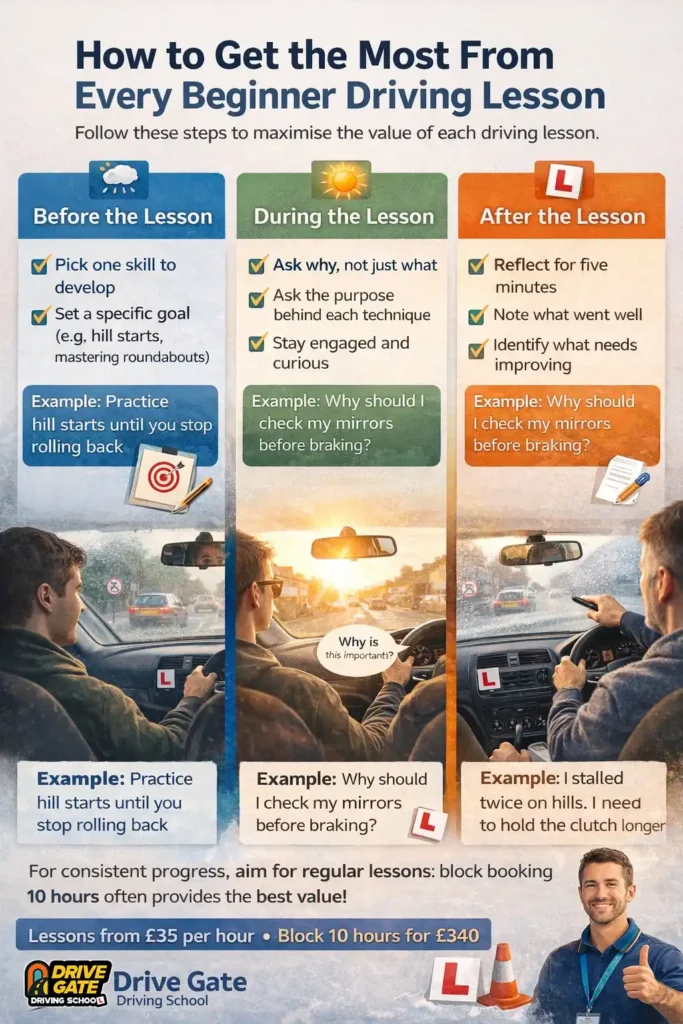
How to Get the Most From Every Beginner Driving Lesson
Frequently Asked Questions About Beginner Driving Lessons
How many lessons does a beginner need?
Most learners need around 45–55 hours of professional lessons plus private practice, depending on progress and road conditions.
What is the hardest part of learning to drive?
Clutch control (manual cars) and junction observation are the most challenging but improve with practice.
Manual or automatic — which is better?
Manual gives full licence flexibility. Automatic is easier but limits you to automatic cars only.
Why do beginners fail the driving test?
Common reasons include poor observation, not using mirrors, unsafe moving off, and traffic sign
How long is a driving lesson?
Typically 1 hour, but 90–120 minutes can help beginners learn faster.
Building a Safe Driver, Not Just Passing the Driving Test
Beginner driving lessons are where lifelong driving habits are built. It’s not just about passing your driving test — it’s about becoming a safe, confident, and consistent driver. Start with the right habits, take your time, and focus on quality learning from lesson one for long-term success on the road.
In conclusion, building strong foundations early ensures you don’t just pass your test — you stay safe and confident on every journey for life.