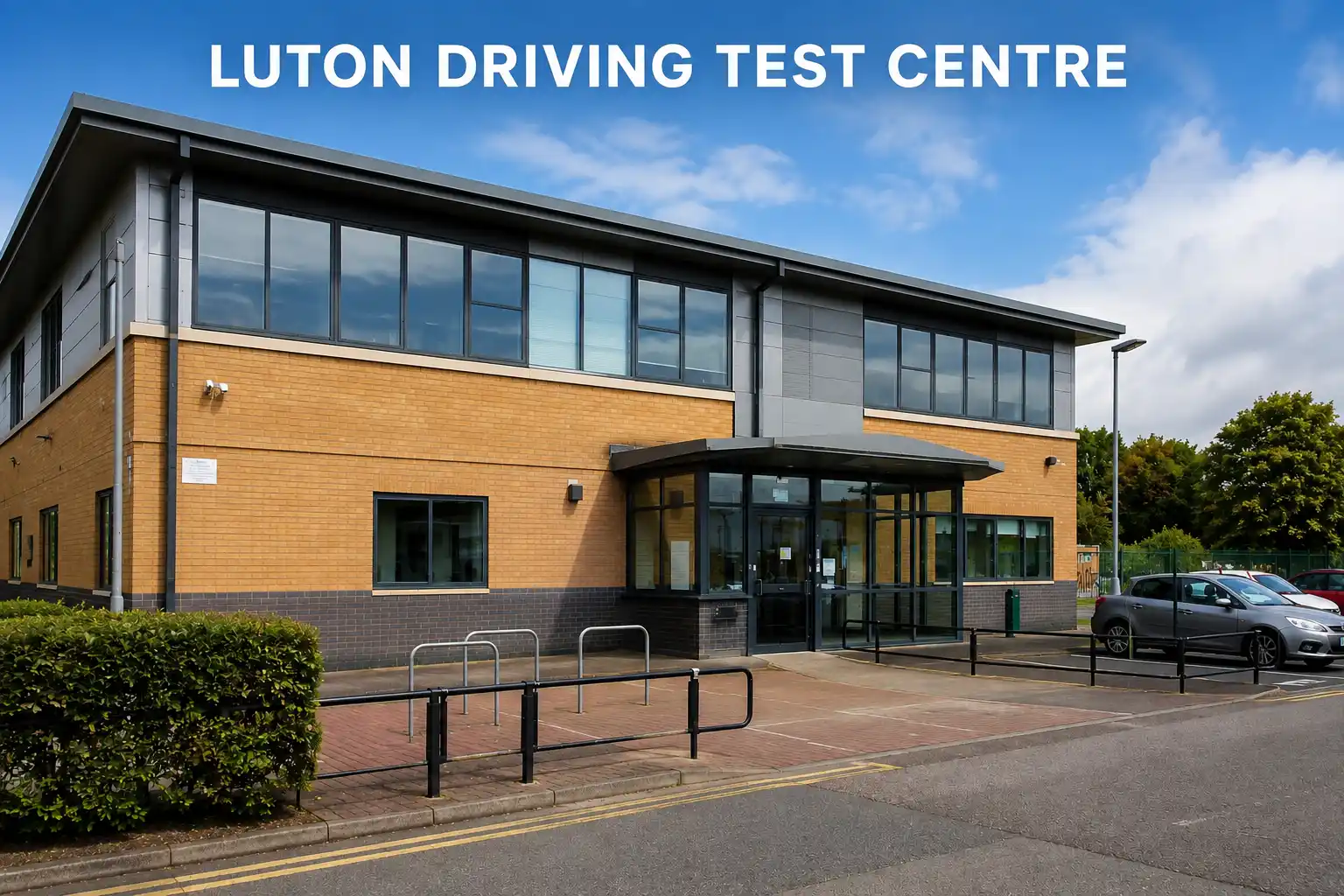
What Happens at Luton Driving Test Centre?
Your practical driving test at Luton Driving Test Centre (Adelaide Street, Luton,
LU1 5BS) lasts around 40 minutes. It includes an eyesight check, one "Tell Me"
safety question, roughly 20 minutes of independent driving (usually sat-nav led),
one reversing manoeuvre, and a "Show Me" question answered while you're driving.
You'll need your provisional licence and a roadworthy, insured vehicle — most
learners test in their instructor's dual-control car. Book with time to spare:
current waiting times at Luton run several weeks out, so lock in your slot as
soon as your instructor says you're ready.
Luton Driving Test Centre — Know This First
Before you even think about test day, these are the facts every learner should have locked in.
What Are the 6 Things You Need to Know About Luton Driving Test Centre?
Know Exactly What Happens During Your Test
Every practical test at Luton — and everywhere else in the UK — follows the same fixed structure. Knowing it in advance is one of the simplest ways to cut pre-test nerves, because there are no surprises left on the day itself.
You'll go through, in order:
- Eyesight check (read a number plate from 20 metres)
- One "Tell Me" vehicle safety question, asked before you move off
- General driving for around 20 minutes across a mix of road types
- Independent driving for around 20 minutes, following a sat nav or a sequence of road signs
- One reversing manoeuvre
- One "Show Me" question, answered while you're actually driving
The examiner is not marking you against a "perfect drive." They're assessing whether you can drive safely, confidently, and independently for the full 40 minutes — a small number of minor faults will not fail you on their own.
- First-time candidates who want to walk in knowing exactly what's coming
- Learners who feel calmer with a fixed structure rather than surprises
- Anyone re-testing after a previous fail, wanting a refresher on format
Get Genuinely Comfortable on Local Luton Roads
DVSA changes test routes regularly and without notice, so trying to memorise a specific route around Luton is largely wasted effort. What actually moves the needle is being relaxed on the types of roads the test area is built from.
Around Luton, that means practising on:
- Residential streets in Bury Park, High Town, and Round Green
- The town centre one-way system
- The A505 and A6 dual carriageways
- Multi-lane roundabouts, including the approach roads to M1 Junction 10/10a
- Mini-roundabouts in residential zones
- Traffic-light junctions on Dunstable Road and Castle Street
- Roads with frequent speed limit changes near schools
A learner who's handled all of the above calmly will cope with almost any route the examiner picks — someone who's only driven one memorised loop will fall apart the moment the route deviates.
- Learners booked to test specifically at Luton
- Drivers who feel confident on quiet roads but tense up on dual carriageways or multi-lane roundabouts
- Anyone whose lessons have mostly happened in one small area and needs broader exposure
Have Every Document Sorted Before You Leave Home
Every test centre in the country, Luton included, sees cancellations purely because a learner turned up without the right documents. It is entirely avoidable and it's one of the most frustrating ways to lose a test slot, because the drive itself was never the problem.
Before you leave home, check you have:
- Your provisional driving licence (photocard — no exceptions, no verbal ID accepted)
- Glasses or contact lenses, if you need them to read a plate at 20 metres
- A roadworthy, taxed, insured vehicle displaying L-plates front and back
- Comfortable, flat shoes you can safely feel the pedals in
Arriving with time spare beyond just "on time" also gives you a few minutes to breathe, use the toilet, and settle before your examiner calls your name.
- First-time learners who haven't been through the process before
- Anyone testing in their instructor's vehicle rather than their own
- Learners who tend to run late or pack last-minute
Understand What the Examiner Is Actually Marking
A lot of learners walk in assuming any mistake is fatal to the test. It isn't. The examiner is trained to assess overall safety and independence, not flawless execution.
Across the 40 minutes, they're specifically watching how you:
- Observe at junctions, roundabouts, and when changing lanes
- Use mirrors before signalling, turning, slowing, or moving off
- Signal at appropriate times — not too early, not too late
- Maintain a safe, appropriate speed for the road and conditions
- Position the vehicle correctly in your lane
- Respond to road signs and markings
- Show awareness of pedestrians, cyclists, and other road users
Minor faults (small, one-off lapses) don't fail a test — you can pick up up to 15 and still pass. It's serious or dangerous faults, or accumulating 16 or more minors, that end the test.
- Nervous learners convinced any wobble means an automatic fail
- Anyone re-testing who wants to understand exactly how marking works
- Learners who fixate on "perfect" driving instead of "safe" driving
Take a Proper Mock Test Before the Real One
A mock driving test is different from a normal lesson. It's run to the same timing, same structure, and same level of formality as the real DVSA test — which is exactly what makes it useful.
A good mock test with your instructor will cover:
- Full 40-minute timing under real test conditions
- A genuine independent driving section with a sat nav
- A "Tell Me" and "Show Me" question, delivered the way an examiner would
- A reversing manoeuvre, marked as the DVSA would mark it
- Feedback afterwards on exactly what would count as faults
The value isn't just confidence — it's that it surfaces the specific habits (a missed mirror check, hesitating at a particular junction type) that are easy to miss in normal lessons but obvious under test conditions.
- Learners who've been told by their instructor they're near test standard
- Anyone who's failed a test before and wants to isolate the cause
- Drivers who want an honest read on readiness before spending £75 on the real thing
Book Early — Luton's Waiting List Moves Slower Than You'd Think
One thing a lot of guides skip: availability. Test slots at busier centres, Luton included, can book out weeks in advance, and cancellation slots get snapped up fast by learners using cancellation-checker tools or apps.
Practical tips:
- Book your test as soon as your instructor gives you a realistic readiness estimate, even if that's 6–8 weeks out — you can always move it later
- See our full guide to booking your driving test for a step-by-step walkthrough
- Check the official DVSA booking service directly, not third-party resellers charging a markup
- Set up cancellation alerts if you want an earlier date — slots do free up regularly
- Avoid booking a date you're not confident you'll be ready for; moving a test costs less stress than failing one you weren't prepared for
- Learners who assume they can book a test the week they feel ready
- Anyone with a deadline (new job, moving away, insurance renewal) driving the timeline
- Learners willing to use cancellation slots to test sooner
Common Reasons Learners Fail at Luton
Even well-prepared learners fail for a handful of repeatable, avoidable reasons. None of these require you to be a "naturally gifted" driver — they're habits.
| Fault | What it looks like | How to avoid it |
|---|---|---|
| Poor observation at junctions | Emerging without a full look both ways, or looking but not actually processing what's coming | Check, assess, then move — treat looking and understanding as two separate steps |
| Missed mirror checks | Not checking before signalling, changing speed, or turning | Build mirror-signal-manoeuvre into muscle memory on every single action, not just the obvious ones |
| Roundabout errors | Wrong lane on approach, late signalling, cutting across lanes | Choose your lane before you reach the roundabout, not while you're on it |
| Poor speed control | Driving too fast for conditions, or so cautiously you hold up traffic | Match speed to the road and conditions, not just the posted limit |
| Letting nerves take over | Freezing or spiralling after one small mistake | Remember: most tests that "felt like a fail" at minute 10 still pass by minute 40 |
Cost & Time to Get Test-Ready
Here's what real preparation costs around Luton, side by side.
| Preparation Method | Typical Cost | Time to Add | Best For |
|---|---|---|---|
| Weekly driving lessons | £30–£45 per hour | Weeks to months | Everyone starting from scratch |
| Mock test with instructor | £40–£60 | 1 session | Learners near test standard |
| Intensive course | £275–£1650 | 1–2 weeks | Fast-track learners with some prior experience |
| Private practice with a supervisor | Free (fuel and insurance only) | Ongoing | Adding extra hours between paid lessons |
| Refresher lessons after a break | £35–£50 per hour | 2–4 sessions | Returning learners who've had a long gap |
A Note for Nervous First-Time Candidates
If test-day nerves are the main thing standing between you and a pass, you're far from alone — it's the single most common thing instructors hear before a test. The format is fixed and predictable, the examiner wants you to pass, not fail you, and the vast majority of learners who feel like they've blown it mid-test still go on to pass.
Practical things that actually help on the day: get a proper night's sleep beforehand rather than a late cram session, eat something light so you're not running on empty, and treat the drive exactly like a normal lesson rather than a performance. Examiners are trained to put learners at ease, not catch them out — the "Tell Me" and "Show Me" questions are the same level of difficulty every time, and there are no trick questions hidden in the route.
What NOT to Do on Test Day
- Don't arrive late. Arrive 10 minutes early — arriving late can mean losing your slot and your fee entirely.
- Don't forget your provisional licence. No licence, no test, no exceptions.
- Don't assume one mistake means you've failed. Keep driving normally until the examiner explicitly tells you the test has ended.
- Don't skip mirror checks under pressure. This is the single most common source of minor faults across all UK test centres.
- Don't try to memorise a "test route." Luton's routes change regularly — adaptability beats memorisation every time.
- Don't rush because you're nervous. A calm, slightly slower drive with good observation beats a rushed, anxious one almost every time.
Frequently Asked Questions
Where is Luton Driving Test Centre located?
How long is the practical test at Luton?
Do I need to pass my theory test first?
Can I use my instructor's car for the test?
Will I need to use a sat nav during the test?
What manoeuvre might I be asked to do?
Can I take the test in an automatic car?
What happens if I fail?
How much does it cost to prepare for a test at Luton?
Are mock tests actually worth the extra cost?
Ready to Prepare for Your Luton Driving Test?
Drive Gate Driving School provides manual and automatic driving lessons, mock tests, intensive courses and refresher lessons across LU1–LU6.