Manual or Automatic — Which Should You Choose?
There's no universal right answer for manual vs automatic driving lessons — it depends on what you'll actually drive afterwards. Manual gives you a licence to drive both manual and automatic cars; automatic restricts you to automatic vehicles only unless you pass a second test later. Pass rates still favour manual slightly (around 47–48% overall versus roughly 42–43% for automatic-only tests), but the UK car market has shifted dramatically — almost 92% of new cars ordered in the UK in the first half of 2026 were automatic, driven by the rise of electric and hybrid vehicles. At Drive Gate Driving School, lesson prices are identical either way — £35 per hour for manual or automatic — so cost shouldn't be the deciding factor. What should decide it is whether you're likely to drive a manual car again in the next decade.
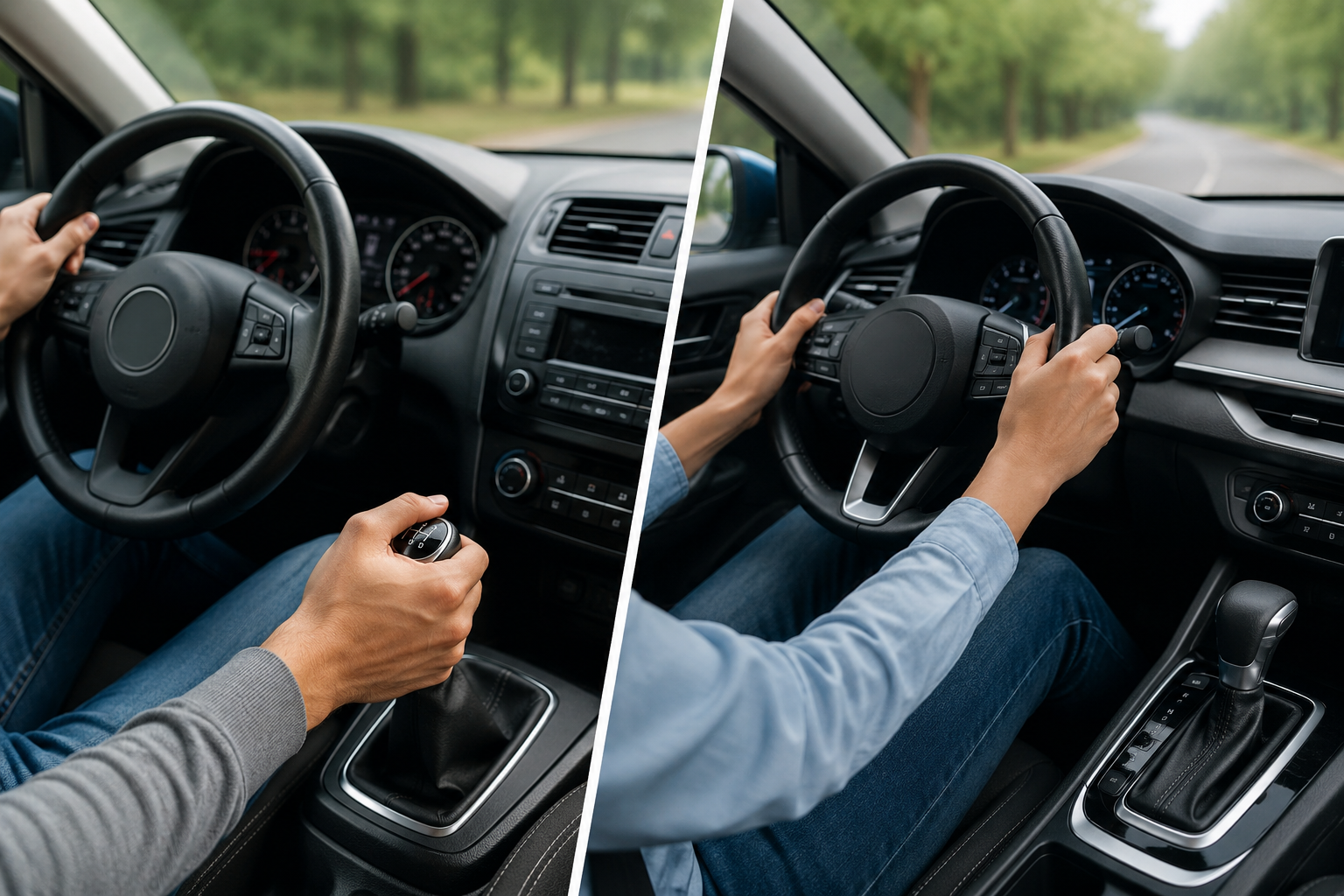
Manual vs Automatic — Know This First
Before you choose, these are the figures every learner should know.
How Do You Actually Decide Between Manual and Automatic?
What's the Real Difference Between a Manual and Automatic Test?
The test itself covers identical ground — eyesight check, "Tell Me/Show Me," independent driving, manoeuvres — the only difference is the physical skill of controlling the vehicle.
- Manual requires coordinating clutch, gears, and accelerator together — the extra skill most learners find hardest early on
- Automatic removes gear changes and clutch control entirely, letting you focus purely on road awareness sooner
- The examiner's assessment criteria — observation, mirrors, positioning, hazard response — are identical either way
- Both licences require the same theory test pass and the same provisional licence process
- Learners unsure what actually differs beyond "gears vs no gears"
- Anyone assuming the automatic test is somehow an easier standard, not just a different skill
- Learners comparing the two before booking their first lesson
Does Learning Automatic Really Mean a Higher Pass Rate?
It's a common assumption that automatic must be easier to pass, since there's one less skill to master — but the data doesn't support that.
- Manual test pass rate: roughly 47–48% nationally
- Automatic-only test pass rate: roughly 42–43% — around 5 percentage points lower
- One likely explanation: automatic learners often reach basic competence faster and book their test sooner, sometimes before they're fully ready
- The gap isn't about difficulty of the transmission — it's about test readiness timing
- Learners assuming automatic guarantees an easier pass
- Anyone deciding whether to rush to test day in an automatic
- Learners wanting accurate expectations rather than assumptions
What Does an Automatic-Only Licence Actually Restrict You From?
This is the single biggest practical difference, and the one most learners underweight when choosing.
- Pass in automatic, and your licence only permits automatic and similar non-clutch vehicles
- Pass in manual, and your licence covers both manual and automatic — full flexibility from day one
- Upgrading from automatic to manual later means taking another full practical test — though not the theory test again
- This matters for renting cars abroad, some job roles (certain delivery, trade, or company car schemes still run manual fleets), and family/friends' cars you might need to borrow
- Anyone who might need to drive a manual car occasionally, even rarely
- Learners considering jobs where a manual company vehicle is possible
- Anyone who travels and might rent manual cars abroad
Is Automatic the Smarter Choice With the UK's Shift to Electric Vehicles?
This is the factor most rapidly changing the calculation — the UK new car market has shifted toward automatic transmission far faster than most people realise.
- Almost 92% of new cars ordered in the UK in the first half of 2026 were automatic — manuals made up just 7.9% of deliveries
- Only 72 of 356 new car models on sale in Britain in 2026 still offer a manual gearbox option at all
- Electric vehicles are automatic by design — there's no clutch or gearbox to speak of
- The UK's ban on new petrol and diesel car sales from 2030 makes this shift structural, not a temporary trend
- If your future driving is likely to be in a newer or electric car, learning automatic increasingly reflects what you'll actually drive
- Learners planning to buy or lease a newer car, especially electric or hybrid
- Anyone whose family car is already automatic
- Learners prioritising what they'll actually drive over long-term flexibility
Which Costs Less Overall in Luton — Manual or Automatic?
At Drive Gate, the hourly rate is identical for both — £35 per hour standard, £34 per hour block booked, £55 per hour for intensive courses. The real cost difference, if any, comes from how many hours each learner needs.
- Automatic learners sometimes reach test standard in fewer hours, since there's one less physical skill to master
- Manual learners sometimes need more hours specifically for clutch control and gear changes before other skills can be layered on
- Neither pattern is universal — natural coordination, lesson frequency, and prior experience matter more than transmission type
- See our full price guide for exact rates across all lesson types
- Budget-conscious learners comparing total likely cost, not just hourly rate
- Anyone assuming automatic must be more expensive by default
- Learners wanting a clear, single price reference across both options
How Do You Actually Decide Which One Is Right for You?
The clearest way to decide isn't which is "easier" — it's which licence matches the car you're most likely to be driving in a year, five years, and beyond.
- If you'll likely drive a family car, company car, or borrowed car that could be manual — choose manual for full flexibility
- If your household car is already automatic, or you're planning to buy new/electric — automatic is the more direct route
- If you're nervous about the physical coordination of clutch control specifically — automatic removes that entire hurdle
- If you want maximum future flexibility with no restrictions at all — manual remains the only licence that covers everything
- Learners genuinely torn between the two options
- Anyone wanting a simple decision framework rather than more statistics
- Learners about to book their first lesson and needing to choose now
What Luton Learners Say About Manual and Automatic Lessons
Real feedback from Drive Gate learners on both sides of the choice.
- Multiple recent reviews specifically praise manual instruction — including learners who passed first time on manual with straight-to-the-point, no-time-wasted teaching.
- Other reviews highlight instructors offering "manual and automatic" flexibly, letting learners switch focus or ask questions about both before committing.
- [Add your own verified split of manual vs automatic bookings, or average hours by transmission type, here once available — real local data strengthens this section further.]
Cost Comparison: Manual vs Automatic in Luton
Identical pricing at Drive Gate — the choice comes down to fit, not cost.
| Lesson Type | Manual Price | Automatic Price |
|---|---|---|
| Standard lesson | £35 / hour | £35 / hour |
| Block booking (10/20/30 hours) | £34 / hour | £34 / hour |
| Intensive course | £55 / hour | £55 / hour |
| Test-day car hire (Luton) | £150 | £150 |
Common Mistakes When Choosing Manual or Automatic
| Mistake | What it looks like | How to avoid it |
|---|---|---|
| Choosing automatic assuming it's "easier to pass" | Booking a test too early, since pass rates are actually lower for automatic | Base test-readiness on your instructor's assessment, not assumptions about difficulty |
| Ignoring the licence restriction entirely | Choosing automatic without considering future manual car access | Think honestly about company cars, family cars, and rentals abroad before deciding |
| Assuming manual is always cheaper | Picking manual purely on a cost assumption that isn't accurate at Drive Gate | Check actual local pricing — many schools charge the same rate for both |
| Switching mid-course | Starting manual, struggling with clutch control, then switching to automatic lessons already paid for | Decide before booking your first block — switching wastes hours already invested |
| Ignoring the EV/automatic market shift | Choosing manual without considering that most new cars are now automatic | Factor in what you're actually likely to drive in the next 5–10 years |
A Note If You're Still Unsure
If you're genuinely torn, it's worth remembering this isn't an irreversible decision — plenty of drivers upgrade from automatic to manual later, or vice versa simply by not driving a manual again. The bigger mistake is spending weeks deliberating instead of just starting lessons in whichever option feels more accessible right now.
A useful, low-stakes way to test your instinct: if you already know your first car after passing will be automatic (or electric), there's little reason to add the extra hurdle of clutch control just for the sake of flexibility you may never use. If you're unsure what you'll drive next, or want to keep every option open, manual remains the only licence that guarantees you're covered either way.
What NOT to Do When Choosing Manual or Automatic
- Don't assume automatic is the "easy option." Pass rates are actually lower for automatic-only tests nationally.
- Don't ignore the licence restriction. An automatic-only licence genuinely limits which cars you can legally drive afterwards.
- Don't assume cost differs without checking. At Drive Gate, manual and automatic lessons are priced identically.
- Don't switch transmission type mid-course. It wastes hours already invested in developing skills specific to one option.
- Don't ignore where the car market is heading. Almost 92% of new UK cars ordered in 2026 were automatic — that's a structural shift, not a passing trend.
Frequently Asked Questions
Is it easier to pass the driving test in an automatic car?
Can I drive a manual car if I pass my test in an automatic?
Do automatic driving lessons cost more than manual?
Why are more people choosing automatic lessons now?
Will manual cars become obsolete?
Do I need to pass the theory test again to upgrade from automatic to manual?
Which is faster to learn — manual or automatic?
Should I choose manual for job flexibility?
Can I switch from manual lessons to automatic partway through?
Is automatic the better choice if I plan to drive an electric car?
Ready to Book, Whichever You Choose?
Drive Gate Driving School offers manual and automatic lessons at the same rate, plus intensive courses across Luton, Dunstable, and Houghton Regis (LU1–LU6), with DVSA-approved instructors experienced in both.